



There are no products in your shopping cart yet.
Where should you send the ashes or hair?
Follow these two questions. Together they determine which address you should use.
- Regular mail — via your country's national postal service (e.g. PostNL, USPS, Royal Mail, Canada Post, bpost, Correos, Australia Post, Poste Italiane, La Poste, NOT Deutsche Post). This can be registered or unregistered letter and parcel mail.
- Courier — a commercial shipping company such as FedEx, DHL, UPS, GLS, DPD, Hermes or Mondial Relay, as well as Deutsche Post. Receipt must always be signed for.
Flowchart
Summary in a table
| Shipping method | From | Address |
|---|---|---|
| Regular mail | Germany | Private address (view address) — always send the tracking number |
| Regular mail | Any other country | Postbox NL |
| Courier | Any country (incl. Germany) | Private address (view address) — always send the tracking number |
Always send the tracking number
This applies to every shipment to my private address: shipments from Germany and every shipment by courier.
IMPORTANT: Are you sending to my private address? Then always reply to the order confirmation right after shipping and include the tracking number. This lets me link the tracking directly to your order. With the tracking I can follow the shipment, see when a delivery attempt is made and — if I am not at home at that moment — see where the shipment can be collected. Carriers rarely leave a notice card these days, so without tracking I will not know that a delivery attempt has been made. If I do not know that a delivery attempt was made and where the shipment can be collected, the shipment will be returned to the sender after one week.
Advice: regular mail is the simplest, cheapest, safest and most reliable option for everyone. Choose a courier only when it is really necessary.
Shipping addresses
PostNL postbox in the Netherlands
Bejora Trading
Postbus 30010
6370 KA Landgraaf
Limburg
Nederland
info@jbmemorials.nl
Private address
For shipments from Germany or with a commercial courier. The address is on a separate page.
After shipping, always reply to the order confirmation with the tracking number.
Packaging and labeling
Make sure the ashes are properly packaged, for example in a securely sealed bag or container. We recommend double-packaging the ashes (approximately 5 ml), for example in two resealable bags or two sandwich bags.
Always include a note with your name and order number. Once we receive the ashes, we can easily match them to the correct order and add them.
Sending ashes from outside the EU
Are you sending the ashes by regular mail from a country outside the EU? There are a few additional points to consider, depending on how you send them.
Simplest method: via a mailbox (no customs form required)
The simplest and most recommended method: package a small amount of ashes (approximately 5 ml maximum) securely in a resealable bag, and place this bag inside a second resealable bag. Put this double-packaged bag in a padded envelope and affix sufficient regular postage stamps (physical or digital). You can simply put this envelope in a regular mailbox — no customs form is required.
Here too, include a note with your name and order number so that we can easily match the ashes to the correct order.
Sending via the post office (with customs form)
If you still wish to send the ashes via the post office, the following information is important.
IMPORTANT: Always include an email address with the shipment. Without an email address, we will not receive notifications about the shipment or any customs clearance charges that need to be paid. If these charges are not paid, the package will be returned to the sender.
Also note the following when completing the customs form:
- Do not enter a high value — do not declare a value higher than $1 or £1. Ashes have no commercial value. If you enter a higher value, we must pay 21% VAT on that value, in addition to the 21% VAT we already pay on the shipping costs you paid.
- Do not enter a zero value — a value of €0 is not permitted.
- Category — enter "gift" or "other" as the category, since the ashes have no commercial value.
Receipt at the postbox (registered shipment)
If you send the ashes by registered mail to our postbox address, the track & trace will show that the shipment can be collected at a PostNL collection point in Kerkrade, instead of at the postbox address in Landgraaf.
There is no need to worry about this: PostNL has consolidated the postbox addresses in this region at one location, at Drukkerij Schreurs in Kerkrade — this is the physical location of our postbox. When a signature is required upon receipt, the shipment is not placed directly in the postbox, and the track & trace shows the location of the printing company.
We visit the postbox twice a week, on Mondays and Thursdays. As soon as we have received your shipment, we will always let you know by message.
Ash jewellery and memorial items
On our website you will find two types of ash jewellery and memorial items:
- Fill yourself at home — jewellery that you fill yourself with a small amount of ashes.
- Processed by us — jewellery in which the ashes, visibly or invisibly, are processed in our workshop.
Fill yourself at home
These pieces of jewellery have a small filling screw. You unscrew it, add a small amount of ashes yourself, and then tighten the screw or closure again. Clear filling instructions are included with these pieces of jewellery.
Some screw closures — for example when the filling screw also serves as the pendant loop — must be glued after filling so that they cannot come loose. Superglue is included with these pieces of jewellery.
Because the filling openings can sometimes be very small in relation to the size of the pendant, some dexterity is required.
Would you rather not fill it yourself at home? We are happy to do this for you for a small additional charge: you send us a small amount of ashes and we fill and seal the jewellery item. You can select this option during the ordering process.
TIP: Not very handy? Have us fill the jewellery item for you — this helps prevent anything from going wrong or getting damaged during filling. Filling it yourself is at your own risk; we are not liable for damage caused by filling or gluing it yourself, such as damaged threads or a broken loop.
Processed by us (visible ashes)
The traditional way of preserving ashes — enclosed in a dark urn or closed ash jewellery — is changing rapidly. Nowadays, there is a strong desire to keep a loved one visibly close: more and more people choose to carry a visible reminder of a loved one with them after cremation, in the form of ash jewellery or a memorial item in which the ashes are partially or fully visible.
We therefore offer a wide, affordable collection of jewellery and memorial items that meet this need.
People usually think of cremated remains as a grey mass of ashes. However, if you look closely at the ashes, you will discover that they are much more than just grey. Take a look at the examples in the photos — you will see that these ashes can be used to create beautiful jewellery, making your loved one visible again, so to speak. This can create a much greater sense of closeness than a closed urn or piece of jewellery.
With these pieces of jewellery, the ashes are processed in a specialist manner, visibly or invisibly. The product description always clearly indicates whether the ashes must be processed by us.
IMPORTANT: Does the jewellery item state that the ashes must be processed by us? This automatically means that a crematorium or funeral director cannot do this — they do not have the necessary knowledge and resources.
Demand for these modern pieces of jewellery is growing because they can be made very exclusive and personal. Jewellery in which ashes are visibly incorporated is not frightening and certainly not unpleasant — it is a tribute to your loved one and a tangible, precious keepsake for you.
We clean and sieve the ashes ourselves. For each piece of jewellery, we determine from the appearance of the ashes which part is best to use: sometimes the finest ashes are best, while sometimes coarser particles look better when incorporated. Do you have any preferences? Please feel free to discuss them with us.
Type of ash processing
For most products in which the ashes are visibly incorporated, you can choose between two processing methods:
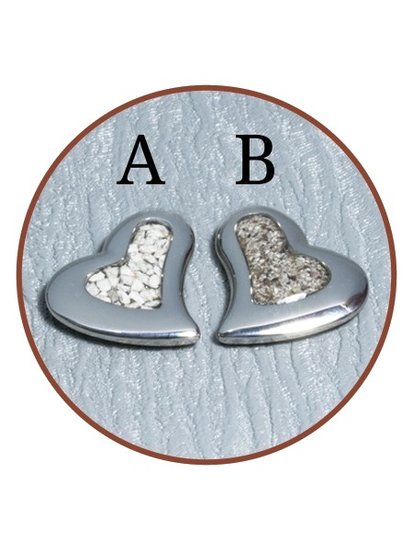
- Arranged — the ashes are sieved so that somewhat larger pieces remain; these are neatly arranged next to each other.
- Fully filled — the larger pieces are sieved out and only the finest ashes and powder are used to completely fill the open space(s) in the jewellery item.
Below you can see an example photo of both processing methods. The colour of ashes may vary in practice: each batch of ashes has a different composition and colour. Finer ashes are usually darker in colour, while coarser pieces are usually lighter. The two hearts in the photo are filled with the same ashes — the difference in colour is clearly visible. You can choose a processing method in the option menus.
We need 1–2 teaspoons of ashes per piece of jewellery. If you choose the arranged processing method, do not send only powdered ashes — we also need the coarser pieces.
Safety of shipping and processing
In principle, it is safe to send ashes by PostNL. Sending them by registered mail is even safer, which is why we recommend sending ashes by registered mail.
Usually only small amounts of ashes are needed — so never send an entire urn. Depending on the jewellery item, we need between half a teaspoon and a few teaspoons of ashes for filling or processing. Filling small urns or figurines naturally requires more ashes, depending on the size of the item.
It is better to send slightly too much ashes than too little — we will return any remaining ashes with your order.
We are fully aware of the responsibility we carry when handling the ashes of your loved ones. You can trust us to treat the ashes with the utmost care and respect, from arrival through processing and shipping.
It is impossible for ashes to be mixed up and end up in the wrong piece of jewellery: within our company, filling and processing ashes is always carried out by the same person. Please make sure that the bag or container with the ashes is labelled with the name and order number, so that any mix-up is completely prevented.
You can therefore entrust your loved one's ashes to us with complete peace of mind.
Care advice for ash jewellery
We strongly advise against wearing ash jewellery — whether filled with ashes or not — while showering, cleaning, swimming, exercising, sleeping, etc.
The resin is water-resistant, but chlorine, cleaning products, soap, salt, acids and sweat can damage the jewellery, any coatings, platings or glued stones. Manufacturers therefore do not provide a warranty for jewellery worn in this way.
A good rule of thumb: jewellery is a luxury item and deserves to be treated accordingly.
NOTE: Washing your hands with mild soap is not a problem, provided you dry your hands immediately afterwards.
If you have any questions about ash processing or sending ashes, please feel free to contact us via the live chat (top left on every page in the webshop) or via the contact form.